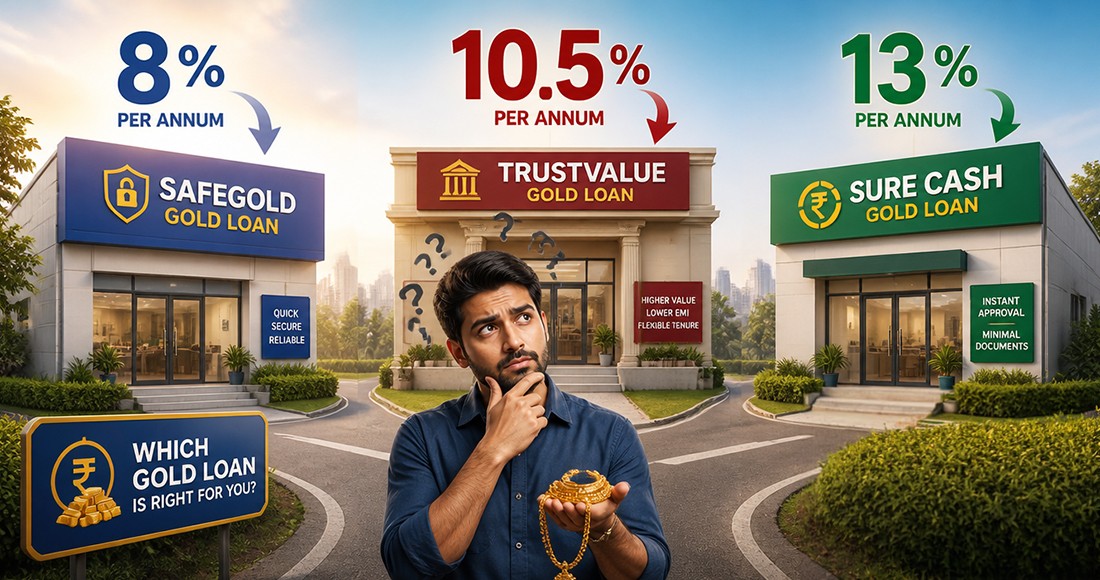
Gold loan rates vary across NBFCs due to funding costs, LTV policies, risk models, and operating expenses. Learn what drives these differences and compare them wisely.
Quick Answer
Different NBFCs offer different interest rates on gold loans primarily because of differences in their cost of funds, operational efficiency, risk appetite, loan-to-value (LTV) policies, target customer segments, and gold valuation practices. Large, well-rated NBFCs can raise money cheaply and pass on lower rates (9%-14% p.a.), while smaller or regional NBFCs with higher borrowing costs and operational expenses charge more (18%–24% p.a.). RBI regulates the maximum LTV at 75% but does not fix interest rates, so each NBFC prices its gold loans based on its own business economics and risk model.
Introduction
If you've ever walked into two different Non-Banking Financial Companies (NBFCs) with the same gold jewellery and come out with two wildly different interest rate quotes, you're not imagining things. Someone could go to three NBFCs in the same week, same gold, same loan amount, and could get rates ranging from 9.5% to 22% per annum. That's not a small gap. That's nearly a 130% difference in borrowing costs.
So, what's really going on? Why does this happen, and more importantly, what should you know before pledging your gold?
Let's break it all down.
What Is a Gold Loan, and Why Are NBFCs So Popular for It?
A gold loan is a secured loan where you pledge your gold ornaments, coins, or jewellery as collateral in exchange for immediate cash. The lender holds your gold until you repay the borrowed amount along with interest.
Many NBFCs companies have become the go-to choice for gold loans for one simple reason: speed and accessibility. They approve loans faster than banks, require minimal documentation, and serve borrowers who may not have a strong credit history.
But here's the catch: unlike banks, NBFCs operate with a lot more flexibility in how they price their products, including gold loan interest rates.
The Core Reason: NBFCs Are Not All the Same
Before diving into the technical factors, understand this fundamental truth. Every NBFC is a different business with a different cost structure, risk appetite, and target customer base. Comparing interest rates across NBFCs without understanding this is like comparing prices at a local Kirana store and a luxury supermarket and wondering why the gap exists.
Here are the key factors that drive this difference:
1. Cost of Funds (The Money They Lend Isn't Free)
NBFCs raise money to lend it out. They borrow from banks, issue Non-Convertible Debentures (NCDs), accept deposits (some NBFCs), or raise equity capital. The rate at which they access this money is called the cost of funds.
- A large, well-rated NBFC can borrow cheaply because it has a strong credit rating (AA or higher). It passes some of that benefit to borrowers.
- A smaller or lower-rated NBFC pays more to raise funds and naturally charges more interest to maintain its margin.
In simple terms: If one lender borrows money at 7% and another at 11%, they cannot both lend to you at 10%. One of them will always price higher.
2. Loan-to-Value (LTV) Ratio Policies
The Reserve Bank of India (RBI) has capped the Loan-to-Value ratio for gold loans at 75%, meaning NBFCs can lend you a maximum of 75% of your gold's current market value. But within that ceiling, different NBFCs offer different LTVs.
Here's the surprising link to interest rates: NBFCs offering higher LTV often charge higher interest, because they're assuming more risk. If gold prices drop suddenly and you default, the lender holding gold at 75% LTV has less buffer than the one who lent at 60% LTV.
The risk premium directly inflates the rate you pay.
3. Operational Efficiency and Infrastructure Costs
A well-oiled NBFC with thousands of branches, trained staff, and automated gold-testing machines operates at lower cost per loan than a smaller player who manually verifies every transaction.
Larger NBFCs spread their fixed costs over millions of loans. Smaller ones can't. That inefficiency eventually shows up in your interest rate.
This is also why urban branch NBFCs sometimes charge more than fintech-driven NBFCs that operate digitally with lower overheads.
4. Target Customer Segment and Risk Profiling
Not all gold loan customers are the same, and smart NBFCs know this.
- Tier-1 customers with higher income, good repayment history, and larger loan amounts get preferential rates.
- First-time borrowers or those with no credit history are often charged higher rates because the lender doesn't know their repayment behavior yet.
- Some NBFCs specifically target rural and semi-urban borrowers who have limited access to formal credit. These segments often come with higher operational costs (rural outreach, regional language staff) and perceived repayment uncertainty, justifying higher rates.
An NBFC that says, "we serve everyone" will price differently from one that says, "we only serve salaried professionals in metro cities."
5. Gold Purity Assessment Practices
This one surprise most borrowers.
Gold purity directly determines loan value. Different NBFCs use different verification methods:
- Some use advanced XRF (X-ray fluorescence) machines that give precise purity readings.
- Others still rely on traditional touchstone methods that can have margins of error.
When an NBFC isn't confident about the exact purity of your gold, it builds a safety margin into the valuation and the rate. They'd rather charge more interest than risk over-lending against an asset they're uncertain about. NBFCs with better technology can be more accurate and, in turn, more competitive on pricing.
6. Tenure and Loan Scheme Structure
Most NBFCs offer multiple gold loan schemes, and each scheme has a different interest rate. Yes, even within the same NBFC, rates differ based on:
- Loan tenure (shorter tenure often means slightly higher annualized rate)
- Repayment mode (bullet repayment vs. monthly interest payment vs. EMI)
- Loan amount slab (smaller loans often carry higher rates due to fixed servicing costs)
So, when comparing NBFCs, you might actually be comparing different scheme types — not apples to apples.
7. Competitive Positioning and Brand Strategy
Some NBFCs deliberately price aggressively to gain market share. Others build brands around "trust" and "customer service" rather than the cheapest rate.
For example, a well-established NBFC might charge slightly higher rates because borrowers trust them to handle their gold safely, have more branch locations, and offer better customer grievance redressal. An NBFC like Kosamattam Finance, which has been operating since 1850 out of Kerala, carries institutional credibility built over generations, and that legacy of trust factors into how it positions itself in the market versus newer or less-established lenders.
Rate isn't everything. Some borrowers willingly pay 1-2% more peace of mind about their gold safety.
8. Regulatory and Compliance Costs
RBI has been increasingly active in regulating NBFCs, from stricter KYC norms to mandatory loan disbursal through banking channels and limitations on cash disbursals above ₹20,000.
NBFCs with better compliance infrastructure absorb these costs more efficiently. Those still building compliance capabilities pass some of those costs through pricing.
A Quick Comparison: What Rate Ranges Look Like in Practice
| NBFC Category | Typical Interest Rate Range |
|---|---|
| Large, listed NBFCs | 9% – 14% p.a. |
| Heritage/regional NBFCs | 10% – 15% p.a. |
| Mid-size regional NBFCs | 14% – 18% p.a. |
| Small/local NBFCs | 18% – 24% p.a. |
| Fintech-backed gold loan platforms | 10% – 16% p.a. |
Note: Rates are indicative and subject to change based on market conditions, RBI repo rate, and individual scheme terms. Always verify current rates directly with the lender.
What Should You Actually Look For? (Practical Advice)
Understanding why rates differ is one thing; using that knowledge is another. Here's what smart borrowers do:
- Compare the Effective Annual Rate (EAR), not just the advertised rate - Some NBFCs advertise monthly rates (like 1.5%/month), which sounds low but translates to 18% annually. Always convert to annual terms.
- Ask about processing fees and other charges - A low interest rate with high processing fees, valuation charges, or foreclosure penalties can be more expensive overall.
- Check the LTV being offered - If two NBFCs offer the same rate, but one gives you 75% LTV and another gives 60%, the first one is effectively cheaper for the same loan amount.
- Understand the repayment of flexibility - Can you pay partial interest monthly? Can you foreclose without penalty? These terms affect your total cost significantly.
- Verify the NBFC's registration and RBI authorization - Always check that the NBFC is RBI-registered. You can verify this on the RBI's official website. Unregistered lenders have no regulatory oversight, and your gold has no protection.
Frequently Asked Questions (FAQs)
Q1: Is the interest rate on gold loans regulated by RBI?
RBI does not fix specific interest rates for gold loans but mandates that NBFCs follow fair practice codes and disclose rates transparently. The LTV ceiling of 75% is regulated.
Q2: Can I negotiate the interest rate on a gold loan?
Yes, especially for larger loan amounts. Many NBFCs have discretionary pricing bands where branch managers or relationship officers can offer better rates for high-value loans or repeat customers.
Q3: Which is better, a bank gold loan or NBFC gold loan?
Banks typically offer lower rates (8%–12%) but are slower and more document-intensive. NBFCs are faster with minimal paperwork but may charge more. Choose based on your urgency and loan amount.
Q4: Does my credit score affect the gold loan interest rate?
For most NBFCs, gold loans are asset-backed and not heavily dependent on credit scores. However, some NBFCs now use credit score data to offer preferential rates to good credit borrowers.
Q5: What happens if gold prices fall after I take the loan?
If gold prices fall significantly and the LTV breaches the permissible limit, the NBFC may ask you to either repay part of the loan or pledge additional gold. This is called a margin call.
The Bottom Line
Different NBFCs charge different gold loan interest rates because they are genuinely different for businesses, with different funding costs, operational efficiencies, risk profiles, technology investments, and customer strategies. There's no single "correct" rate; there's only the rate that makes sense for that particular lender economy.
As a borrower, your job is not just to find the lowest rate; it's to find the best overall deal that balances rate, LTV, safety, transparency, and flexibility.
Gold has always been a store of value in Indian households. When you're putting that gold on the line for a loan, you deserve a lender who values it as much as you do, and prices fairly for the privilege of holding it.