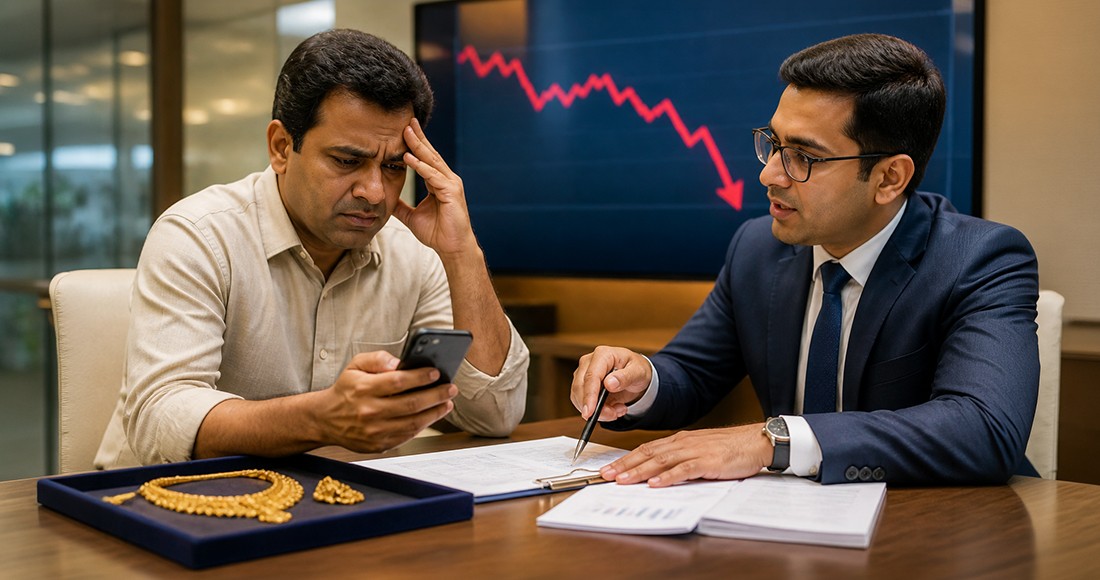
A drop in gold prices can affect your gold loan through higher LTV ratios and possible margin calls. Learn the risks, lender actions, and smart ways to stay protected.
If you've taken a gold loan and you're now watching gold prices dip in the news, that little knot of worry in your stomach is completely normal. You pledged something valuable, maybe a family heirloom, your wedding jewelry, or gold you'd been saving for years, and now you're wondering if a price drop is going to come back to bite you.
Here's the short answer: yes, a fall in gold prices can affect your loan, but it's rarely as dramatic as people fear, and there's a lot you can do to stay protected. Let's break down exactly what happens, why it happens, and how to handle it like someone who actually understands the system, because once you do, the anxiety mostly disappears.
Quick Answer (For Those in a Hurry)
When gold prices fall, the market value of the gold you've pledged drops too. Since lenders calculate your loan amount based on a percentage of your gold's value (called the Loan-to-Value or LTV ratio), a falling price can push your LTV above the regulatory limit. When that happens, your lender may ask you to either pay down part of the loan, pledge more gold, or pay the difference. This is called a margin call. If you ignore it for too long, the lender has the right to auction your gold to recover their money.
Now let's get into the details, so you actually understand the "why" behind all this, not just the "what."
First, A Quick Refresher: How Gold Loans Actually Work
When you take a gold loan, the bank or NBFC (Non-Banking Financial Company) doesn't lend you the full market value of your gold. Instead, they lend you a percentage of it, currently capped at 75% by the Reserve Bank of India's regulations for most gold loan providers.
So, if your gold is worth ₹1,00,000 on the day you pledge it, you might get a loan of up to ₹75,000. That 25% buffer isn't random; it exists specifically to protect the lender (and indirectly, you) against exactly the situation we're discussing: a fall in gold prices. If you want to see where you stand right now, a gold loan calculator can give you a quick estimate of your current eligible amount based on today's rates.
This buffer is your safety cushion. As long as gold prices don't fall too sharply, that cushion absorbs the shock, and you never even notice anything changed.
So, What Actually Happens When Gold Prices Drop?
1. Your Collateral's Value Shrinks, But Your Loan Amount Doesn't
This is the core issue. Let's say you borrowed ₹75,000 against gold worth ₹1,00,000 (a 75% LTV). If gold prices fall by 10%, your gold is now worth only ₹90,000. But you still owe ₹75,000. Suddenly, your LTV jumped from 75% to roughly 83%, above the permitted limit.
Your loan amount stays fixed. It's the value of what's backing that loan that has changed. This mismatch is what triggers everything else on this list.
2. The Lender Issues a Margin Call
Once your LTV breaches the regulatory or internal threshold, most lenders will reach out to you with a margin call notice. This isn't a punishment; it's a standard risk management step that every gold loan provider, from large PSU banks to NBFCs, is required to follow. The exact thresholds and timelines here have also shifted somewhat with the RBI's updated 2026 gold loan norms, so it's worth knowing which rules currently apply to your specific loan.
A margin call typically asks you to do one of the following:
- Pay a partial amount of the loan to bring the LTV back within limits
- Pledge additional gold to restore the collateral value
- Pay the accrued interest if that's what's pushing the ratio up
Most lenders give you a reasonable window, often a few days to a couple of weeks, to respond. This isn't something that happens overnight or without warning in a well-regulated lending environment.
3. If You Ignore the Margin Call: Auction Risk
This is the part people fear most, and rightfully so, but it's important to understand it's a last resort, not a snap decision by the lender. If you don't respond to the margin call within the stipulated time, the lender has the legal right to auction your pledged gold to recover the outstanding loan amount plus interest.
Reputable lenders follow a structured process before auctioning, usually laid out in their published auction policy:
- Multiple reminders via SMS, calls, and registered post
- A public notice (often in newspapers) before the auction date
- The auction itself, usually conducted transparently with bidders
- Any surplus amount (after deducting the loan and dues) is returned to you
So even in a worst-case scenario, you're not simply going to "lose" your gold without notice or without getting back the difference if your gold sells for more than what you owe.
4. Your Credit Score Could Take a Hit
If you default on a margin call and the loan turns into a non-performing asset (NPA), it gets reported to credit bureaus. This can lower your credit score and make it harder to get loans in the future, a consequence that often outlasts the gold loan itself.
A Realistic Example to Make This Click
Let's walk through real numbers.
Priya takes a gold loan in January 2026. Her gold is valued at ₹5,00,000, and she borrows ₹3,75,000 (75% LTV) for 12 months at typical NBFC interest rates.
By April 2026, gold prices fall by 12% due to global market shifts. Her gold's current value is now around ₹4,40,000. Combined with three months of accrued interest added to her outstanding balance, her effective LTV climbs to about 88%, well above the permitted threshold.
Her lender sends a margin call asking her to either deposit ₹35,000 to bring the ratio down or pledge an additional 50 grams of gold. Priya chooses to pay the partial amount since she has the funds available. Her loan continues normally, and she avoids any risk to her pledged jewelry entirely.
This is how it plays for the vast majority of borrowers, manageable adjustments, not a crisis.
How to Protect Yourself From the Start
You don't have to wait for a margin call to feel anxious about it. A little planning when you first take the loan, or even now, if you already have one, goes a long way.
Borrow conservatively. If the maximum LTV offered is 75%, consider taking 60-65% instead. That extra buffer gives you a breathing room if prices dip.
Track gold prices periodically. You don't need to obsess daily, but checking in monthly helps you spot trends early instead of getting blindsided by a notice.
Keep some funds set aside. Even a small emergency fund equal to 10-15% of your loan amount means you can respond to a margin call immediately instead of scrambling.
Choose shorter loan tenures when possible. The longer your loan runs, the more interest accrues, and accrued interest adds to your effective LTV over time, separate from price movements entirely.
Read your loan agreement auction clause. Know your lender's specific notice period and process before you need it. This single step removes most of the uncertainty people feel.
Consider part-prepayment when prices are still favorable. If you notice gold prices trending downward and you have surplus funds, prepaying a portion of your loan proactively can keep your LTV comfortably within limits.
Does a Rise in Gold Prices Help You?
Yes, interestingly, the reverse is also true. If gold prices rise after you've taken off your loan, your LTV ratio improves in your favor. In some cases, depending on the lender's policy, this can even allow you to borrow additional funds (a top-up loan) against the increased value of the same pledged gold, without needing fresh collateral. There's a deeper look at this two-way relationship in how gold prices impact gold loan rates, if you want to understand the mechanics beyond just margin calls.
This is a useful thing to know because it reframes from gold loans not as a one-directional risk, but as something tied to a market that moves both ways.
Common Questions People Ask About This
Will my gold be sold immediately if prices fall?
No. A price to fall alone doesn't trigger an auction. It only matters if your LTV crosses the lender's threshold, and you fail to respond to subsequent margin call communications within the given timeframe.
How much can gold prices fall before I get a margin call?
This depends on your original LTV at loan disbursal and the lender's specific risk policy. Borrowers who started at a lower LTV (say 60%) have a much larger price-fall cushion than those who started at the maximum of 75%. Sharp single-day drops, like the one covered in this recent account of a gold price fall and its effect on loans, tend to prompt lenders to review borrower LTVs more closely than gradual declines.
Can I switch lenders if I'm worried about margin calls?
Yes, gold loan balance transfers exist and are fairly common. If another lender offers better LTV terms or interest rates, you can transfer your existing loan, though it's worth comparing processing fees before deciding.
Does the type of gold (jewelry vs. coins/bars) affect this risk?
Lenders typically value pledged gold based on purity (usually 22K or lower, after deducting stone weight), not on whether it's jewelry or bullion. The price-fall mechanics work the same way regardless of form.
The Bigger Picture
A falling gold price is genuinely just market movement; it's not a verdict on your financial decisions, and it's not something that catches well-prepared borrowers off guard. The system is built with checks (the LTV cap, margin calls, notice periods) specifically so that a price dip translates into a manageable conversation with your lender, not an automatic loss.
If you're currently holding a gold loan and feeling uneasy about recent price movements, the most productive thing you can do isn't to panic, it's to calculate your current LTV, check your lender's threshold, and reach out proactively if you're getting close to the limit. Lenders generally prefer a borrower who communicates early over one who waits for formal notice.
Gold loans remain one of the most accessible and reasonably structured forms of secured credit precisely because of these safeguards. Understanding them turns a scary headline about "falling gold prices" into just another factor you're equipped to manage.